
Early Accident Anticipation with Video Transformers
- Status
- In Progress
- Period
- University thesis — in progress
- Confidentiality
- Public. Public university thesis repository. Dataset access, third-party terms, and incomplete evaluation status remain visible.
A thesis prototype investigating temporal accident anticipation and fixation-derived supervision with explicit result-integrity safeguards.
I'm exploring early traffic-accident anticipation from dashcam video through a thesis prototype, using temporal sampling, Tiny3D and MViTv2-oriented paths, earliness-aware loss, optional fixation supervision, and sequence evaluation. A result audit found duplicated video rows and conflicting labels, so I'm withholding quantitative claims until the evaluation input is corrected and regenerated.
- Type
- University
- Categories
- AI & Machine Learning
- Data & Dashboards
- Technologies
- Python
- PyTorch
- torchvision
- timm
- NumPy
- scikit-learn
- Matplotlib
- pytest
Context
Researchers and engineers interested in causal video modeling, accident anticipation, and evaluation integrity.
- The dataset, trained checkpoints, and full ML environment are not included.
- Committed evaluation summaries contain duplicate keys and conflicting video-level labels.
- Dataset reuse terms and repository licensing require clarification.
Problem
The research asks whether video models can identify accident risk early and whether fixation-derived supervision provides a useful auxiliary signal, while avoiding future-frame leakage and invalid aggregate conclusions.
My contribution
I built data loading and sampling, Tiny3D and MViTv2-oriented model paths, classification and fixation heads, earliness-aware training, sequence evaluation, threshold and mTTA-related output, deterministic setup, checkpointing, and comparative probability-timeline visualization.
Approach
Resolve video annotations, form causal temporal inputs, encode clips, predict accident likelihood, optionally supervise a fixation distribution, evaluate probability over time, and audit every result artifact before publishing performance conclusions.
Artifacts
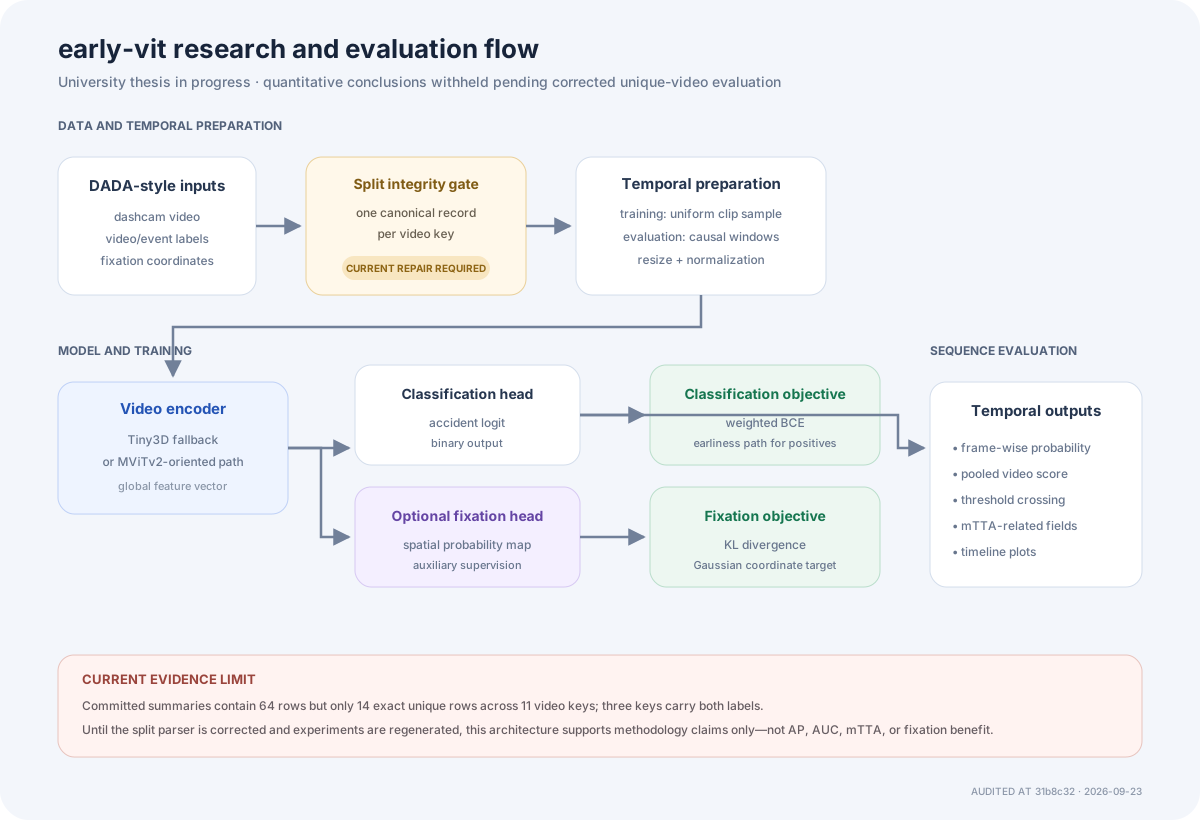
Model and evaluation flow (Diagram) Open full-size visual: Model and evaluation flow
Outcomes
- Implemented the full research prototype and probability-timeline visualization path.
- Traced repeated evaluation rows to an annotation-row versus video-key granularity mismatch.
- Withheld unsupported AP, AUC, mTTA, and fixation-benefit claims.
Limitations and current status
- No quantitative model-performance result is currently publishable.
- Full tests, training, and plot reproduction require unavailable dependencies, data, and checkpoints.
- The split parser and time-to-event targets need correction before the next evaluation.
Links
- Repository
- github.com/SyedIshmumAhnaf/early-vit